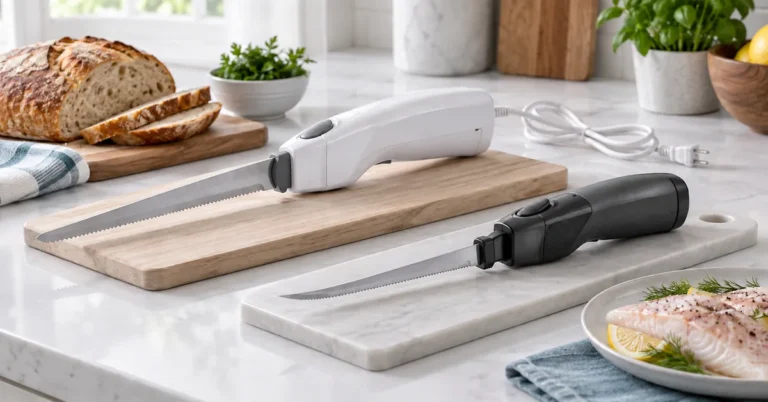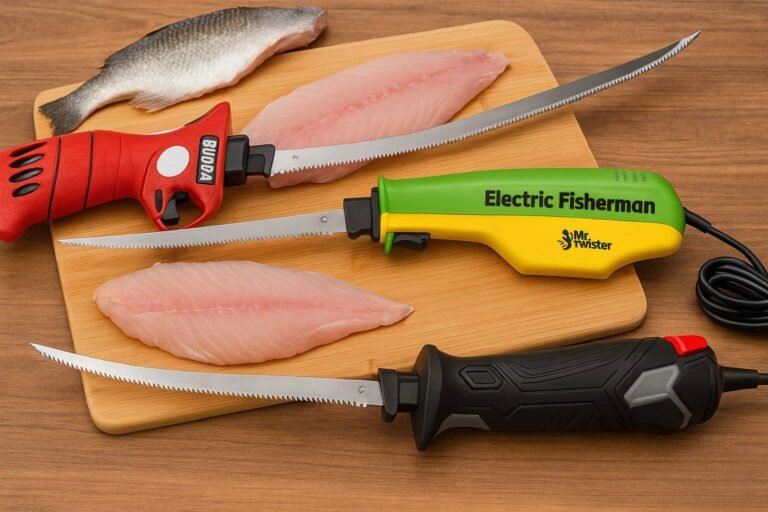
Start with the place where you clean fish, not with a claim that one power source is always stronger. A corded knife needs its specified external power supply and a safe cable route; many models use a mains outlet. A cordless knife removes that cable during cutting, but adds battery charging and storage to the routine. Neither choice tells you, by itself, how well a particular blade and handle will suit your work.
Build the decision around your cleaning station
At a fixed table, look at outlet access, the position of the fish, and where your hands will move. If a cable can remain clear of the cutting path and wet areas, corded power can be straightforward. If you routinely move between suitable workstations, a cordless design may remove an awkward cable constraint. Some corded kits support manufacturer-specified external-power adapters, so outlet placement is not the whole category distinction. Use only the supply and connections approved for the exact model. Cordless mobility is not permission for outdoor or wet use: check the manual’s permitted environment and work-surface precautions.
Connected power still has operating limits
A mains-powered corded model avoids an onboard battery’s charging and runtime limits while connected to a suitable supply. That does not establish unlimited operating duration. Follow the exact model’s operating, cooling and ventilation instructions. Plan the session around safe handling and the manufacturer’s limits rather than assuming outlet power guarantees uninterrupted cutting.
Battery ownership extends beyond a single session
For cordless models, check the exact kit: compatible batteries, charger, charge indicator and replacement-battery support. A spare battery may be useful if supplied or supported, but it is not a promise of unlimited runtime. Check the conditions behind any runtime claim: for example, Rapala’s R12 manual labels its runtime specification as no-load. Charging and storage instructions also vary by battery system. A model’s quoted runtime is not a guarantee of time spent cutting your fish.
Compare the knife as well as its power source
Power source is only one part of the choice. Check the manufacturer’s permitted cuts and available blade options, then inspect the grip, trigger, safety lock and blade release. Do not infer a lighter or heavier complete knife from its power source; compare actual model specifications. Photographs can help explain the controls, but they cannot establish personal comfort. We have not physically tested these categories and do not declare a cutting-speed, torque or durability winner.
For the broader buying framework, see our guide to choosing an electric knife. For model-level options and their qualifications, see our electric fillet knife recommendations.
Plan safe care and storage
Disconnect power as directed before handling or cleaning the blades: unplug a corded model, or follow the cordless model’s instructions for battery removal or isolation. Separate power-system care from blade care: inspect a cord and plug for damage; for a cordless model, check its battery and charger instructions. Blade washing, drying and replacement requirements remain model-specific rather than being determined by corded or cordless power. Do not assume either power source makes the motor housing, battery or electrical connections suitable for immersion.
Care instructions can differ between models and sources. The Rapala Heavy-Duty Corded review documents a model-specific cleaning disagreement and its conservative handling policy. That exception should not be generalized to every electric knife.
What this comparison can and cannot decide
This is a research-based comparison of ownership and workspace tradeoffs, not a head-to-head cutting test. It can help you decide whether cable routing or battery management is the more acceptable constraint. It cannot establish the best model for your hand, a guaranteed runtime, or a universal performance advantage. Verify the current model’s manual and kit before choosing. Sources checked on 28 September 2026 include Rapala’s electric-knife and R12 manuals and BUBBA’s corded and cordless product documentation.
GoPolli research sources and evidence notes — October 2026
Manufacturer documents support model specifications. Videos and retailer reviews describe third-party experiences, not GoPolli hands-on testing. Retail listings can mix variants; confirm the exact model before applying customer feedback.